
August 18, 2023
As your business grows, ensuring your data infrastructure scales accordingly becomes a critical necessity. However, this pursuit is not without its challenges, particularly when it comes to managing the associated costs. One area where expenses can quickly accumulate is in the development, maintenance, and scaling of data pipelines. Therefore, it’s important to consider cost-effective technologies that can meet the increasing demands of your business without making your CFO hyperventilate.
Understanding the factors that affect working with data at scale can help you design cost-saving strategies, so you can derive value from your data without putting a strain on your budget.
In this article, you’ll learn why cloud costs can spiral when processing and storing big data and how to minimize compute costs with Bodo’s efficient compute engine.
As Biggie once said, “mo’ data, mo’ problems.” Well, maybe that wasn’t the exact lyric, but it’s the truth. As your business scales, your data volumes grow, your pipelines become more complex and fragile, and next thing you know, your cloud bills have left an impressive hole in your roof as they rocket skyward.
Hiding from the entire finance department can be pretty draining, so let’s break down the main drivers of these costs and then dive into how to reduce them.
Processing power is a significant part of the cost of working with big data. Sorting, indexing, and aggregation can take a long time to complete and require many resources. So, when it comes to compute costs within ETL pipelines, it’s essential to consider the pricing structure of the data warehouse or cloud-based solution you’re using.
Some data warehouses charge you based on the compute resources you use and the data you process. As a result, processing large amounts of data can require substantial compute resources, leading to soaring costs. If this scenario sounds a bit too familiar, optimizing your data pipelines is likely a critical consideration. Processing the same amount of data more efficiently and with fewer resources helps reduce costs drastically.
Most often, complex queries read more data and require more processing resources during execution. Heavier resource use means higher costs.
And executing these queries more efficiently requires additional optimizations or indexing. Again, greater optimization takes additional compute resources, further ballooning your already-climbing costs. This phenomenon, often called a “runaway query,” consumes a disproportionate number of resources, becoming far costlier than anticipated.
Optimizing and simplifying queries where possible is vital to tame the costs surrounding complex queries. Doing so may entail modeling data differently or breaking a query into smaller tasks. Additionally, using efficient query engines and optimizing code can help minimize the compute resources required to execute complex queries. The Finance Divines smile on you.
Cloud providers offer different storage types with varying costs. Object storage is generally less expensive than block or file storage but may not offer the same level of performance or durability. For large-scale use cases, cloud-based block storage can be expensive, as data is broken into fixed-size blocks and requires additional storage to scale out.
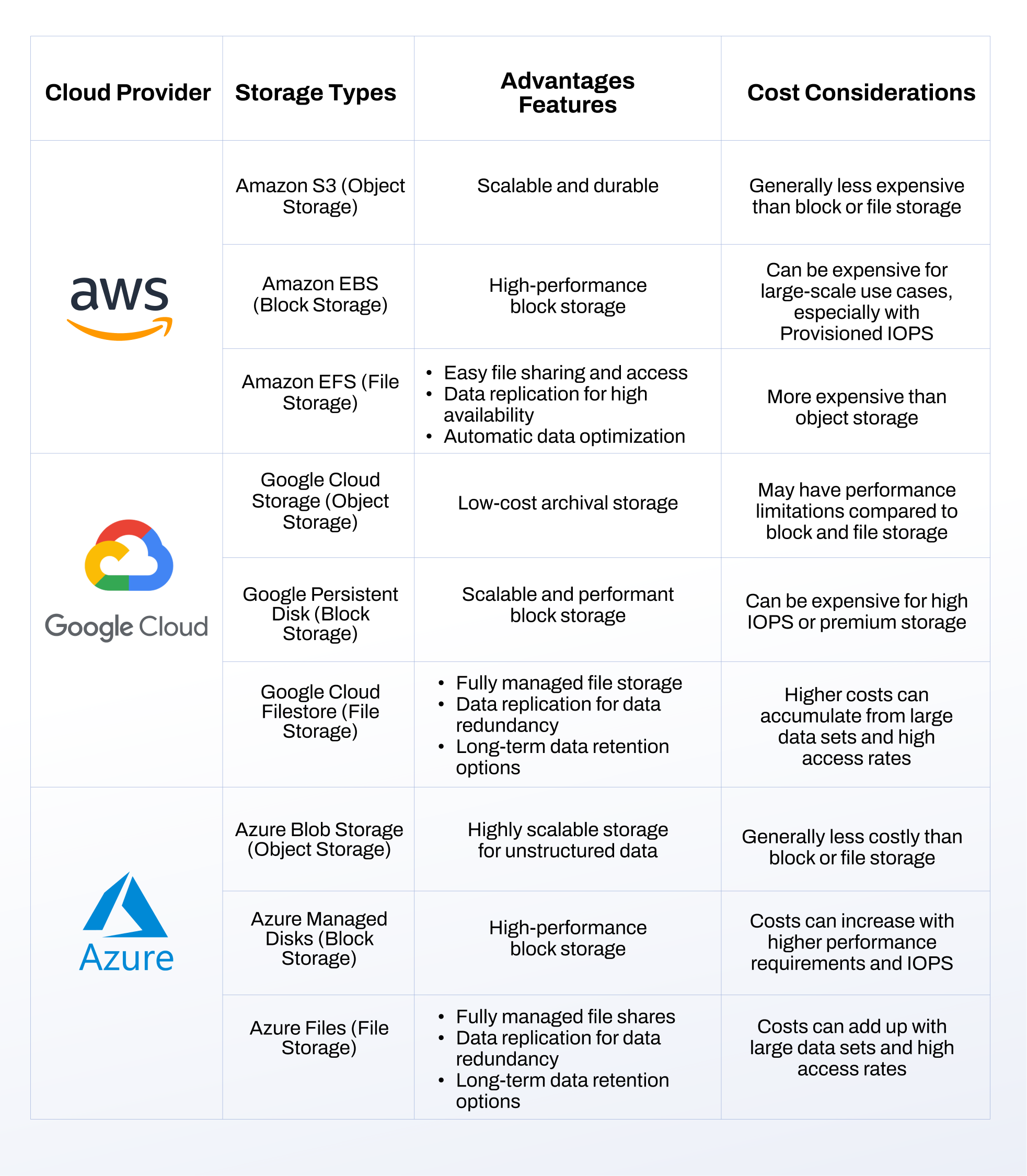
In many cases, data platforms provide data retention options that let users store data for longer periods, which can increase storage costs. And advanced features like automatic data optimization, sharing, and data replication, all provide significant benefits but make for a hefty bill.
Cloud providers typically offer various instance types, each with a different number of nodes and processors. Still, they may not let you choose the precise number of these resources, making it challenging to select the right instance type and resource usage for a particular big data project.
It can also be difficult to find an effective scaling strategy that doesn’t risk over- or under-provisioning resources. Achieving the right balance takes experimentation and observation — guesswork won’t suffice. If your big data project requires more resources than anticipated, it can be hard to scale up resources quickly enough to meet its requirements. On the other hand, if you overestimate the project’s resource needs, you might waste resources and overspend unnecessarily.
Apache Spark is an open source distributed computing framework designed for large-scale data processing a common big data platform for large-scale SQL, machine learning, batch processing, and stream processing. Spark’s ability to distribute processing tasks across multiple nodes in a cluster allows it to process large datasets much faster than traditional single-node processing. Spark performs distributed computing on its own or in conjunction with other distributed computing tools, providing native R, Python, Java, SQL, and Scala bindings.
But with this great power comes great financial consideration.
One of the costs associated with Spark’s architecture is the computational expense of moving data between nodes in the cluster. To enhance job performance, Spark often moves data between nodes and caches it in memory. However, this requires more expensive hardware with larger amounts of memory. If Spark jobs are not optimized, memory usage and cost increase.
Complex Spark jobs may require larger or more specialized clusters to execute efficiently, which can further drive up compute costs. These costs must be considered and optimized to ensure you’re not spending more than necessary on compute resources.
Bodo is a high-performance SQL and Python compute engine. Our customers use our platform for their largest, most demanding, most expensive data engineering workloads, and Bodo can make them faster and more cost-effective. Our compute engine uses advanced high-performance computing (HPC) and compiler techniques to make ETL and other compute heavy workloads more efficient.
Bodo is often more efficient than alternatives like Spark, especially for ETL and data prep workloads, because we’re the first compute engine to leverage the full parallelism of Single Program Multiple Data (SPMD), bringing HPC levels of performance and efficiency via MPI.
The diagram below demonstrates parallelism in Bodo:

Bodo consumes less computing time and is faster than Spark, with a median speedup of 2-3x with up to 50-60 percent lower compute costs. Bodo is built for large-scale data workloads requiring hundreds of compute cores, billions of rows, and terabytes of data.
Bodo is built to scale seamlessly, so you can process large volumes of data without stressing over performance and cost. More readily handling increasing data volumes ensures you can focus on deriving insights from your data rather than wondering when overspending will come back to bite you.

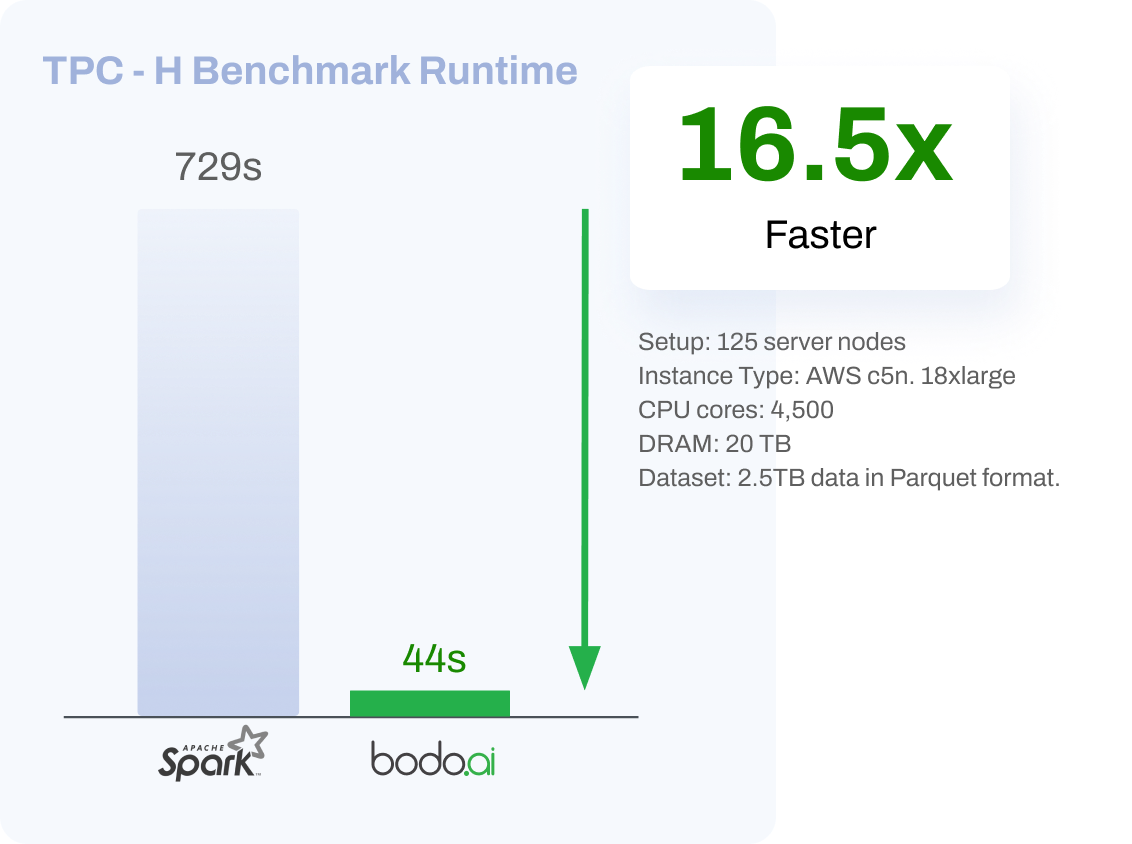
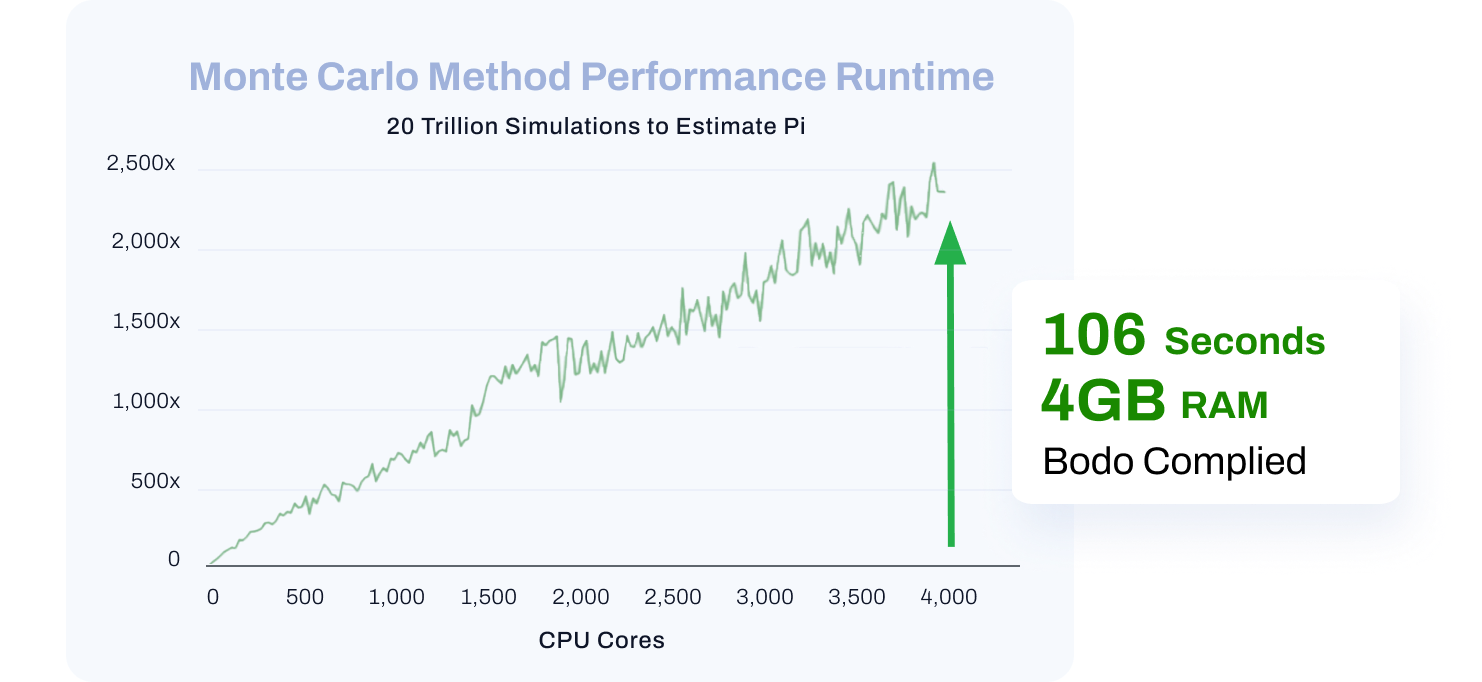
By leveraging parallelization techniques and optimizing data movement, Bodo can significantly reduce the time and resources required to process large datasets for scenarios like compute-intensive workloads that perform mathematical computations. This efficiency not only improves the speed of data processing tasks but also helps reduce cloud costs by requiring fewer compute resources to accomplish the same work.
Let's delve into the core technologies that power Bodo's performance:Some of the key benefits of using Bodo include:
Compute and data storage costs, complexities of scaling, and the complexity of Spark are all key factors that inflate cloud costs when processing and storing big data. Big data tools have introduced cost-saving features to help customers reduce their bills and manage cloud expenses more efficiently.
Bodo was built with cost-saving in mind, with features that support parallelism, minimize query run times, enable fast processing of large ETL workloads, and avoid extra scrutiny from the penny pinchers upstairs.
Bodo is a data processing platform built for high-performance and scalability. Move your most expensive, longest-running workloads to Bodo to decrease your costs by up to 90 percent.