
June 24, 2026
Ehsan Totoni
AI is changing expectations for data analytics. Today, users want to ask questions about their data and receive answers immediately, regardless of dataset size or query complexity. At the same time, AI agents increasingly rely on fast access to enterprise data to perform tasks efficiently. As a result, low-latency query execution at scale has become more important than ever.
In this post, we introduce the latest version of BodoSQL, designed for high-performance interactive query execution on massive datasets. Available in the BodoSQL 2026.6 release, this update introduces a new C++-based execution backend that dramatically reduces query startup latency while preserving the scalability and performance that BodoSQL is known for.
We’ll explore the architecture of the new backend, explain how it differs from the original JIT-based implementation, and demonstrate the performance improvements it delivers.
BodoSQL is an open-source, distributed SQL engine designed for high-performance analytics. It provides:
At the core of BodoSQL is a dynamic programming-based cost optimizer that searches for the most efficient execution plan. Optimizations include:
Built on top of Apache Calcite, BodoSQL can perform advanced optimizations that go far beyond what traditional rule-based optimizers can achieve.
BodoSQL uses a Single Program, Multiple Data (SPMD) execution model built on MPI. In this model, all workers execute the same program while operating on different partitions of the data.
Unlike task-based execution frameworks that rely on a central coordinator to distribute work and manage execution, MPI enables workers to communicate directly through peer-to-peer and collective operations. This approach minimizes coordination overhead and can deliver significantly higher performance at scale.
The execution engine also shares many battle-tested components with Bodo JIT and Bodo DataFrames, providing a mature foundation for large-scale analytics workloads.
Historically, BodoSQL was optimized for batch analytics and data engineering workloads, where maximum execution performance is the primary goal. The original backend relied on Bodo JIT to compile each query into a highly optimized native binary. While this approach delivers exceptional runtime performance, compilation can take several seconds. For batch workloads, this overhead is often negligible because queries are executed repeatedly after compilation.
Interactive analytics, however, has very different requirements. Users expect results within seconds, making query startup latency a critical factor.
To address this need, we developed a new C++-based backend that executes queries through a runtime system rather than generating a standalone binary for every query. Because execution can begin immediately after the physical plan is generated, startup latency is dramatically reduced.
The new backend shares its core runtime with Bodo DataFrames, allowing us to reuse existing high-performance components and accelerate development while providing seamless interoperability with Python, Pandas, Bodo JIT and Bodo DataFrames.
To execute queries on the new backend, BodoSQL performs several plan transformations:
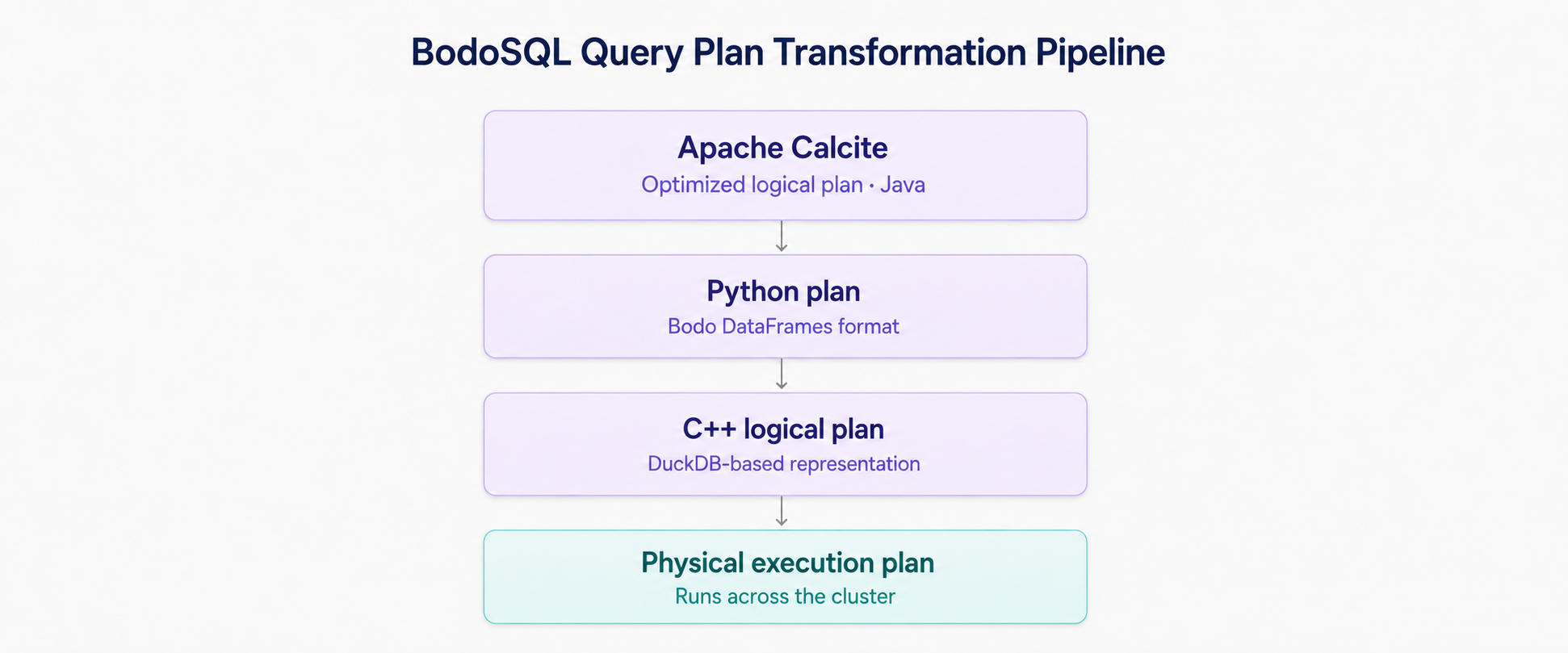
By leveraging the same execution infrastructure as Bodo DataFrames, we gain both engineering efficiency and deep integration with the broader Python and Bodo ecosystem.
The C++ backend is being developed incrementally. When a query contains features that are not yet supported, BodoSQL automatically and transparently falls back to the existing JIT backend.
This hybrid approach allows users to benefit from lower latency immediately while preserving compatibility with existing workloads. As development continues, more query patterns will execute entirely on the C++ backend, further reducing end-to-end latency.
To measure startup latency, we ran TPC-H Query 5 on a local Mac laptop using a small dataset. It took 4s with the new C++ backend versus 27s with the previous JIT backend. The new backend reduced execution startup time by nearly 7x, demonstrating its potential for interactive analytics workloads where responsiveness is critical.
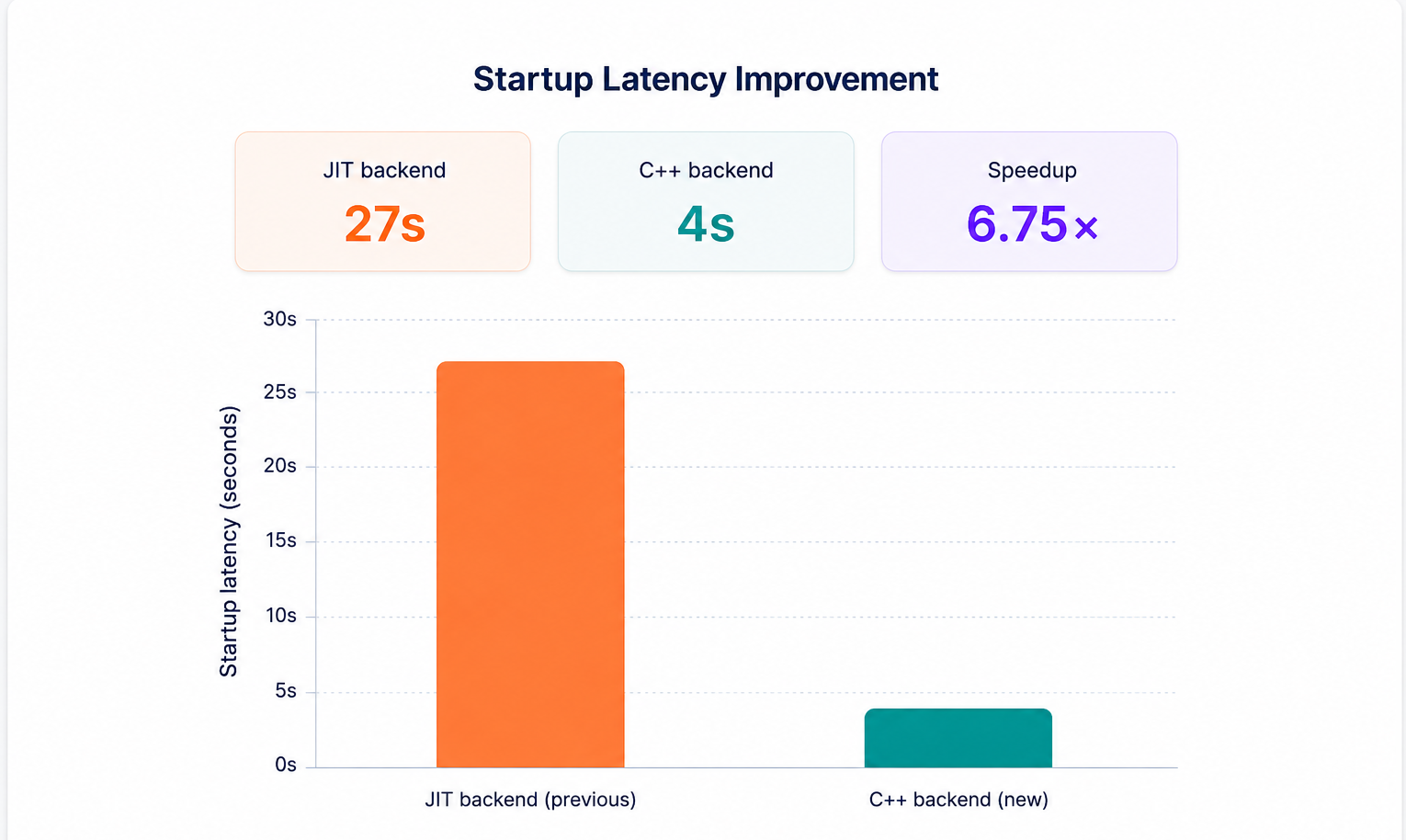
While this benchmark focuses on a single query, it illustrates the fundamental advantage of the runtime-based architecture: eliminating expensive query compilation significantly improves the interactive user experience.
The AI era demands fast, interactive access to data at any scale. Users and AI agents alike need query results in seconds, not minutes.
With the introduction of the new C++ backend in BodoSQL 2026.6, we’re taking a major step toward that goal. By replacing per-query compilation with a high-performance runtime execution engine, BodoSQL can deliver dramatically lower startup latency while retaining the scalability and performance advantages of its distributed architecture.
The C++ backend is still under active development, and support will continue to expand over future releases. As more workloads transition to the new backend, users can expect even lower latencies and a smoother interactive analytics experience.
To get started using BodoSQL yourself:
And join the Community Slack to stay in the loop on product releases, new features, and other updates.
We look forward to hearing your feedback as we continue building the next generation of interactive analytics with BodoSQL.